Parents Should Look at KidPass

As a parent, I’m always looking for new things to do with my kids.

Sure, they’d be perfectly content with going to Chuck’E’Cheese (or equiv) every time, but I need the variety and they need exposure to different activities so they learn to love exploring and trying new things and eventually find their passion.


Kidpass is only in New York right now, but they just raised $5.1 million to help expand their business and replicate the model in other major cities, starting with Boston, Chicago, Los Angeles, San Francisco, and Washington DC.

Here in Orange County, I’m always searching for activities for us to do. But I feel that I’ve exhausted searches on my usual sources. I’m sure there are a lot that I don’t know about. In fact, just this week, we found one called SenderCity. It’s a rock climbing facility. This place was GREAT and it was located almost right next to Rock’n’Jump (trampoline park) that we have been to quite a number of times.

I like how Kidpass has layed out the UI so that I can browse the activities by different criteria. I especially like the ability to browse by day.

The only deterrent could be the cost, but take that with a grain of salt because I really haven’t looked at it in-depth at all. I simply make that comment upon glancing at the plans and seeing the credits needed to do a couple of the activities. That said, if it exposes to new things for 1-time (where you’d normally pay more or have to do a longer commitment), then that could be worth the premium.

Understand Your Edge

I’ve been reading a lot about copywriting, persuasion, and sales strategies recently (I need to be writing about that more). It is a fascinating topic. And when I say copy, this incorporates (verbal) sales messaging. It makes me wish I had taken more philosophy and psychology classes in school.

In business and in any realm where there is competition you need to beat, it’s crucial to understand your edge. Why should the buyer select your product or your service? We live in the information age and it is almost certain that the buyer can/will research the competition (although, in simplistic transactional sales, this can be countered by techniques like limited time offers).

The copy needs to reflect this edge. Does your edge solve a pain point and/or deliver a pleasure? Your copy needs to amplify the pain and pleasure points and it needs to specifically do so around your edge.

One edge that a small company can have over a big corporation is speed. I really like John Boyd’s OODA loop. John Boyd was a F-86 Pilot and Commander in the US Airforce.

Boyd believed that when at a disadvantage, a competent pilot could still overcome that disadvantage by “Attacking the Mind” of his opponent. The OODA loop is a process that defines how we react to stimulus.
“In order to win, we should operate at a faster tempo or rhythm than our adversaries—or, better yet, get inside [the] adversary’s Observation-Orientation-Decision-Action time cycle or loop … Such activity will make us appear ambiguous (unpredictable) thereby generate confusion and disorder among our adversaries—since our adversaries will be unable to generate mental images or pictures that agree with the menacing, as well as faster transient rhythm or patterns, they are competing against.”

Colonel Boyd trained his pilots based upon his observations of Human reaction time and as a result his pilots had a 10 to 1 kill ratio over the superior Mig-15’s.

“The key is to obscure your intentions and make them unpredictable to your opponent while you simultaneously clarify his intentions. That is, operate at a faster tempo to generate rapidly changing conditions that inhibit your opponent from adapting or reacting to those changes and that suppress or destroy his awareness. Thus, a hodgepodge of confusion and disorder occur to cause him to over- or under-react to conditions or activities that appear to be uncertain, ambiguous, or incomprehensible.”

The OODA loop has become an important concept in many areas outside of air-to-air combat (dog fighting).


The Internet is the Battleground for Perpetual Warfare

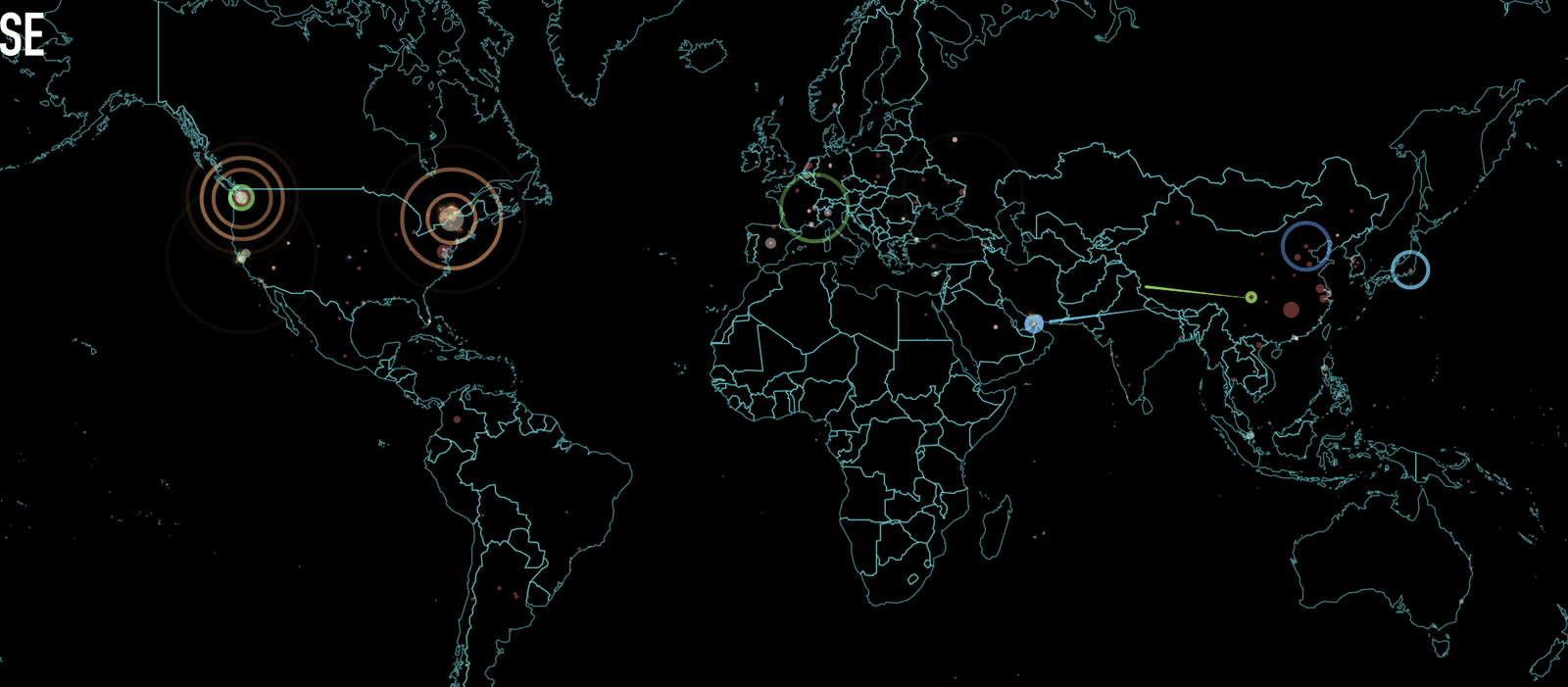
Norse has a really, really cool real-time visualization of cyber attacks. It’s quite mesmerizing to watch.

Most of the attacks stem from US and China, at least in the few minutes that I watched. What’s interesting is that you see big name corporations as the Attackers. I happened to notice A LOT of Microsoft Corporation. I have no idea what that means; I’m very from being any kind of security expert. I just noticed this and thought, “hmmm”.

I’m sure this is just a fraction of what goes on out there. Which makes this pretty scary. I’ve been in software a long time and I’ve never come across or heard of code that didn’t have bugs or couldn’t be hacked.

Add to that the fact that we have assigned some of the best and brightest to find all these holes (re: Wikileaks CIA hacking tools release and NSA leaked hacking tools).

And then of course I’m always reading about how fragile, old and outdated our infrastructure is. We’re so exposed. Is a nuclear threat really the biggest threat out there?

Hold Hold Hold … It’s So Hard Not to Sell

BitCoin and Ethereum (as well as other cryptocurrencies) are on a parabolic trajectory. It’s so hard not to sell here. I mean, when you’ve 3x and 6x your investment and you see this trajectory, isn’t it prudent to take some winnings off the table?

I would say normally, taking some off the table (at least lock in the initial investment so that what’s left is “house” money). But here is my investor greed setting in, perhaps.

I truly believe that this is really only the very very beginning and HUGE gains are ahead because the blockchain technology is that revolutionary. I don’t want to get into the mindset of trading in and out because the Fear Of Missing Out (FOMO) if I sell will kill me more.

I don’t have a huge portion of my portfolio allocated into these, so I can afford to lose it all and still sleep at night. These really are like lottery tickets, but I like the odds here.

I’m considering diversifying and buying into some Ripple. I’ve been reading that Tezos is also an ICO to watch for. These aren’t as simple to buy, though. I mean, they aren’t hard, but I’d have to set up other wallets.

Interesting times…

Seth Rich Story could get VERY Interesting

Do you know who Seth Rich is? This story is going to make one heck of a movie one day, I’m sure. Or at least a season of Serial podcast by Sara Koenig.

In short, Seth Rich was a 27-year old employee of the Democratic National Committee (DNC) who was murdered on July 10, 2016; shot while walking home from his neighborhood bar. He was shot twice in the back. He was found conscious, but then died in the hospital.

The media reported that it was an attempted robbery. Apparently, he had bruises on his hands, knees, and face; indicating a struggle. But the really interesting fact is that nothing was taken from him. He had his watch, money, his credit cards, his phone…nothing was robbed.

The conspiracy theories are out in droves. The primary conspiracy story is that Seth Rich is the one who leaked DNC emails to WikiLeaks, which led to the firing of Debbie Wasserman Shultz.

Julian Assange in an interview last August hinted that Seth Rich was the leaker, but never explicitly admitted it.

Supposedly, one of the FBI or the DC Police have his laptop, but neither is pressing forward with any investigation with it. Apparently, the DC Police didn’t even interview any of the bar staff of the venue Seth Rich was in that night.

I’m trying not to get sucked in to the lure of a great conspiracy story, but man, this one smells of something.

Then, to top it all off, Kim Dotcom, yes that guy of all people, tweets out the other day:

Seems so random…

…The story is that Kim Dotcom is seeking revenge against Hillary Clinton and Obama, as they succumbed to Hollywood power brokers and targeted Kim Dotcom in the biggest copyright infringement case in history – which included a massive illegal (and then legal) raid on his New Zealand mansion by armed officers.

Let’s see what he comes out with on Tuesday…

Silicon Valley is Losing her Luster

According to The Kaufman Foundation 2017 Startup Activity report, SF & San Jose slipped several spots. Cities such as Miami, Austin, and Los Angeles are moving up. St. Louis, Cincinnati and San Antonio are cities that jumped up the most.

Silicon Valley will always be Silicon Valley. It is la creme de la creme. But it makes perfect sense, and is good overall, for entrepreneurship to extend beyond the valley.

The greatest concentration of engineers is in the valley. The greatest concentration of venture money is in the valley. But if I’m starting a new company, I wouldn’t start it in SF; it’s just too darn expensive.

We used to live up in SF area and we have a strong network still there. But, even if we wanted to move back, it would be extremely difficult to do (while maintaining the same lifestyle). The bang for the buck is so much better outside of the valley. As a company, I think you could attract the talent with a pretty good salary (but much less than a SV rate) and better cost-of-living. A $200K salary in the bay area is perhaps $100-120K outside, but that person can get a 3-Bdrm, 2-Bath house for $250K Vs $2M.

We’ve thought about moving out of California as well because the state taxes are ridiculous. This makes Texas and Florida very appealing (we do enjoy the sun). But alas, California weather is the best. Where else can you Snowboard and Surf on the same day?

I do like the start-up activity moving south. Los Angeles is nice, but the traffic is terrible. I’d love to see more companies moving down to Irvine. It will happen, I’m certain, the appeal is too great (think SF to San Jose). If a company is really good, the talent and money will come to it.

3 Little-Known Companies Helping Shape the Movement to Autonomous Vehicles

Quanergy, Velodyne, and Luminar Technologies. They are all LiDAR technology companies.

LiDAR is how the vehicles detect what is around them. LiDAR sensors measure distances by measuring the Time of Flight (TOF) that it takes a short laser pulse to travel from the sensor to an object and back, calculating the distance from the known speed of light.

Each of those 3 companies has raised many millions in early rounds (none beyond Series B). According to James Altucher sources, they each carry a $1B+ valuation which puts them in the Unicorn classification. (I can’t link to the source because it is an insider newsletter)

James believes that Velodyne is the clear leader at this point. Velodyne raised $150M in August 2016 from investors that included Ford, Google, and Baidu. He mentions that Velodyne’s products are currently being used in 25 different self-driving programs.

Of course, as private companies, we can’t invest in these companies. But James is recommending to look at Ford as a way into Velodyne.

Of all the car companies, I do like Ford the best. They have made interesting investments and partnerships. My wife has a Ford Focus and it’s a pretty decent car.

I can’t bring myself to invest in car companies at this time, though. I’ve been reading too much about sub-prime car loans going bust, similar to how sub-prime housing went bust in 2007. Obviously, the car market isn’t nearly as big, but it’s still significant.

I’m currently short GM and that is going pretty well so far…


5 Ideas for Chorus.ai

I have no affiliation with Chorus.ai. I read about their Series A funding in February and upon learning about their solution, I was intrigued enough to request a demo.

Again, I only had a single brief demo, so I’m no expert. But, essentially, what Chorus.ai does is record and automatically transcribe meetings so that they can be used for review and coaching/training purposes. It also syncs to SalesForce; which is awesome, assuming that what syncs are the meeting notes or a summary of the transcription (full transcription could be too much).

“If I have a thousand ideas and only one turns out to be good, I am satisfied.” — Alfred Bernhard Nobel

In any case, I’m sure they have plenty of ideas to spend the newly minted $16M raised capital. Here are my 5 ideas for Chorus.ai:

  1. Give a Free (or very cheap) Single License to Very Early Start-ups. When it is early and there is no sales team, the early conversations with customers/prospects can be the foundation of training for the first sales hire. It’s hugely valuable for a new rep to hear the real pitch in action, the reception by the prospects, the objections and the overall context of how these conversations go. Founders can also get outside coaching from Advisors. And lastly, as the company grows and builds out its sales force, Chorus.ai is already part of the fabric of the company, up-selling to regular seat licenses (or whatever the model) should be easy.
  2. Offer a Self-Serve Single Seat License. Perhaps a company isn’t ready to bite on a company-wide licensing deal. However, individual reps could be interested. As a rep, I would be interested if there was a self service sign-up (and individual plan advertised on the website); no demo. It would save me LOADS of time putting notes into Salesforce. This should easily pay for itself in saved hours and pain of data entry. Then Chorus.ai can shift to account based marketing and level up within the org to managers/VPs.
  3. Target Inside Sales Teams. For the enterprise deals, target the inside sales teams first. These folks are typically more junior and need more coaching and are more open to adoption new solutions. Also, if I were an outside rep being passed a lead, I would certainly invest the time to listen to the call that qualified the lead. At that point, you’re also seasoning the outside team with the value of Chorus.ai. Lastly, if my company was using an out-sourced business development team, I would definitely want a solution like Chorus.ai in place as an oversight mechanism. This is not saying to ignore the rest of the sales org, but targeting inside sales and inside sales managers on a smaller deal could lead to accelerated deals and then easier up-sells.
  4. Market to Marketing Too. Have Marketing contribute to the budget (or at least get them into the groundswell. Marketing campaigns can be expensive. Therefore, Marketers usually A/B test things before they scale campaigns. Chorus.ai enables Marketing to work with a sales rep or two to test different messaging on a smaller, but still effective, scale. Also, by searching for trigger words like “competition”, they could get early indicators of new market threats and understand when it’s time to craft a campaign to combat them.
  5. Invest in SEO. I like the Chorus.ai tag line “Conversation Intelligence” as a branding tag line, but I doubt that anyone searches for that term. But I bet that people are searching for “sales call recording software” or “sales coaching solution” and derivatives of those. Writing blog posts and PR with long-tail terms around those core themes could help attract leads more cost effectively.

What do you think about these ideas? I enjoy these kind of brain exercises. If you’re interested in getting any kind of ideas for your company or job or other, simply drop me a private message and ask. I’d be happy to turn on the Thinkolator for you. 🙂